 By Ava Sinclair, Beauty Editor
Reviewed & updated August 2026
A great skincare routine can still fail if the products go on in the wrong order. Layering isn't just a nice-to-have ritual — it determines whether each product can actually reach the skin and do its job, or whether it just sits on top of something else and goes to waste.
This article shares general skincare information, not medical advice. See a dermatologist for concerns specific to your skin.
 Skip ahead toCurated by Ava · 7 min read
The general rule: thinnest to thickest
The simplest way to think about layering is texture. Apply products from the thinnest, most watery consistency to the thickest, most occlusive one. Thin products (like toners and essences) can absorb quickly into clean skin, while thick products (like creams and oils) sit on top and seal everything underneath.
If you apply a heavy moisturizer first, it creates a barrier that lighter products afterward simply can't penetrate. That's the single most common layering mistake — and it quietly wastes the money spent on serums that never get to do their job.
The correct order, step by step
1. Cleanser — always the first step, morning and night, to remove dirt, oil, and (in the evening) makeup or sunscreen.
2. Toner or essence (optional) — a thin, water-based liquid that preps skin and adds a first layer of hydration. Pat it in rather than rubbing.
3. Treatment serums — this is where active ingredients like vitamin C, niacinamide, or exfoliating acids go. Apply the thinnest serum first if you're using more than one.
4. Spot treatments — targeted products for specific concerns (like a blemish gel) go on next, applied only where needed.
5. Eye cream — a lighter formula for the delicate under-eye area, applied with the ring finger.
6. Moisturizer — locks in everything applied below it and adds its own hydration. This step should never be skipped, even on oily skin.
7. Face oil (if you use one) — oils go after moisturizer, not before, since they're occlusive enough to block anything applied on top.
8. Sunscreen (morning only) — always the last step of a daytime routine. It needs to sit on top to form an effective protective layer.
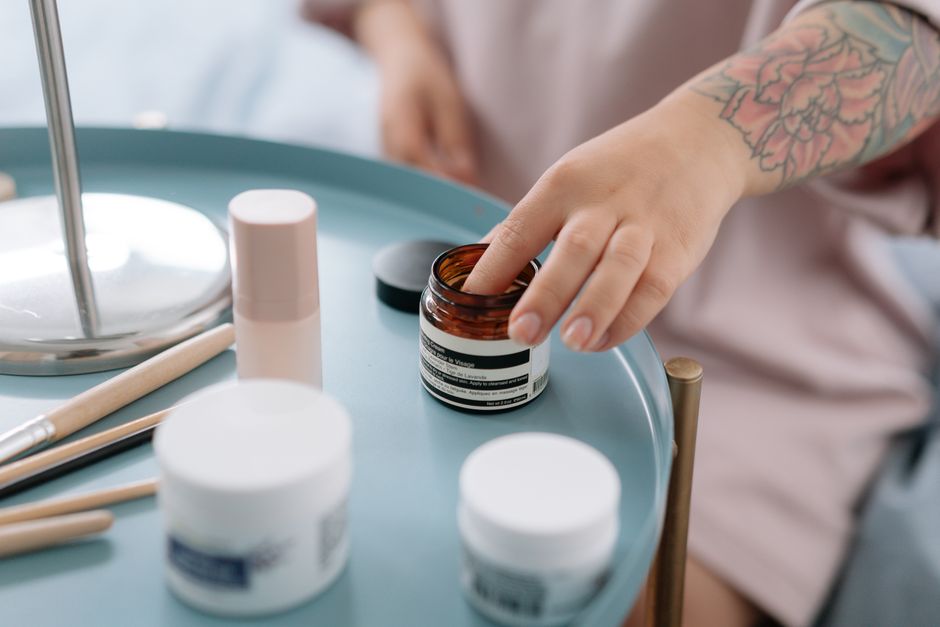
How long to wait between layers
For most everyday products, waiting 30-60 seconds between layers is enough to let each one absorb before the next goes on. Active ingredients with a specific pH requirement — like vitamin C or exfoliating acids — benefit from a slightly longer wait, closer to 5-10 minutes, so they aren't diluted or destabilized by the next product going on too soon.
You don't need to time this obsessively. A reasonable rule of thumb: if your skin still feels tacky or wet, give it another minute before continuing.
Ingredients that shouldn't be layered together
Not every combination plays nicely. A few pairings are worth separating into different parts of your routine (or alternating days):
- Retinol and exfoliating acids (AHA/BHA) — layering both can over-exfoliate and irritate skin. Use one at night and the other on alternate nights, or one AM/one PM.
- Vitamin C and niacinamide — older guidance said to avoid these together, but modern formulations are generally fine layered; if your skin is sensitive, space them by using vitamin C in the morning and niacinamide at night.
- Benzoyl peroxide and retinol — benzoyl peroxide can reduce retinol's effectiveness when applied at the same time; use them at different times of day if you need both.
If you're unsure whether two actives conflict, the safest approach is using one in the morning and the other at night rather than stacking them in a single routine.
Morning vs evening layering differences
Morning routines are built around protection: a lighter lineup ending in sunscreen, since the goal is shielding skin from UV and environmental stress throughout the day.
Evening routines are built around repair: this is when heavier actives like retinol, and richer moisturizers or facial oils, do their best work, since skin isn't exposed to sun or pollution while you sleep.
Keeping a simpler AM routine and saving the heavier actives for PM is one of the easiest ways to avoid over-layering and irritation.
Common layering mistakes to avoid
Applying serum on top of moisturizer. This is the most common mix-up — moisturizer should almost always be one of the last steps, not sandwiched in the middle.
Skipping sunscreen because moisturizer has SPF. Most moisturizers with SPF don't apply the film thickness needed for the labeled protection. Use a dedicated sunscreen as the final step.
Rubbing products in aggressively. Especially with serums, gentle patting helps the product absorb rather than pushing it around and losing product on your hands.
Using too many actives at once. More layers isn't automatically better — piling on five active ingredients raises irritation risk without adding proportional benefit. A focused 4-5 product routine, applied in the right order, usually outperforms a crowded 8-step one.
The takeaway
Correct layering comes down to one principle: thinnest to thickest, watery to oily, with sunscreen always last in the morning. Give each layer a short window to absorb, keep conflicting actives on separate days or times of day, and resist the urge to overcrowd your routine with more products than your skin can actually use well.
Frequently asked questions
Do I really need to wait between skincare layers?
For everyday hydrating products, a quick 30-60 second pause is enough. For pH-dependent actives like vitamin C or acids, waiting closer to 5-10 minutes helps them work as intended.
Can I skip moisturizer if my serum feels hydrating enough?
No — moisturizer serves a different job, sealing in the water-based serums underneath and reinforcing your skin barrier. Even oily skin benefits from a lightweight, oil-free moisturizer.
Does face oil go before or after moisturizer?
After. Oils are heavier and more occlusive than moisturizer, so applying them last helps seal everything underneath rather than blocking the moisturizer from absorbing.
Is it bad to use too many skincare steps?
It can be — more products means more chances for ingredients to conflict or irritate skin. A focused routine with 4-5 well-chosen products applied in the right order is usually more effective than a crowded 8+ step one.
Read next


Further reading & trusted sources
The step most people skip
Applying moisturizer before a serum is the single most common layering mistake, and it’s a quiet one — the routine still ‘feels’ complete, but the serum underneath simply can’t penetrate a barrier that’s already sealed, so the active ingredient gets wasted without any obvious sign anything went wrong. The pH-dependent actives (vitamin C, exfoliating acids) are the real exception to the usual 30-60 second rule between layers; those genuinely benefit from a longer 5-10 minute wait so the next product doesn’t destabilize them before they’ve had time to work.
Ava reads the ingredient list long before the marketing claims — what interests her is which actives are genuinely proven and which are just a pretty bottle and a big promise. She leads GlowNourish’s skincare, makeup and hair coverage with one simple test: would this advice still hold up if a dermatologist read it? Every guide is researched with the help of AI tools and then human-edited for accuracy — no invented ‘clinical results’ and no fake reviews. For a real skin concern, she’ll always point you to a professional.